 Add to Chrome
 Add to Firefox
 Add to Edge
Triaging Threats to Specialized Guardrails
May 29, 2026
Building robust safety guardrails is essential for deploying Large Language Models across diverse real-world applications. However, this goal remains challenging because safety risks span heterogeneous threat domains, while existing datasets cover only fragmented risk subsets and rely on inconsistent taxonomies. Consequently, it remains unclear whether current guardrails can generalize beyond narrow evaluation settings. To better understand the robustness of guardrail models, we first introduce GuardZoo, a unified human-annotated benchmark with 32,460 samples covering 15 distinct unsafe categories. Evaluation on GuardZoo reveals that monolithic guardrails suffer from task interference: different threat domains require distinct decision boundaries that are difficult to compress into a single model. We therefore propose RouteGuard, a router-expert framework that triages each conversation to specialized expert guardrails for threat-specific detection. Experiments show that RouteGuard improves fine-grained threat detection over strong guardrail baselines, generalizes better under out-of-domain evaluation, and supports flexible modular expansion to emerging threats.

EnvFactory: Scaling Tool-Use Agents via Executable Environments Synthesis and Robust RL
May 18, 2026Equipping LLMs with tool-use capabilities via Agentic Reinforcement Learning (Agentic RL) is bottlenecked by two challenges: the lack of scalable, robust execution environments and the scarcity of realistic training data that captures implicit human reasoning. Existing approaches depend on costly real-world APIs, hallucination-prone LLM simulators, or synthetic environments that are often single-turn or depend on pre-collected documents. Moreover, synthetic trajectories are frequently over-specified, resembling instruction sequences rather than natural human intents, reducing their effectiveness for RL training. We introduce EnvFactory, a fully automated framework that addresses both challenges. EnvFactory autonomously explores and verifies stateful, executable tool environments from authentic resources, and synthesizes natural multi-turn trajectories through topology-aware sampling and calibrated refinement, producing grounded queries with implicit intents. Using only 85 verified environments across 7 domains, EnvFactory generates 2,575 SFT and RL trajectories. Despite using significantly fewer environments than prior work, which are often 5 times more, EnvFactory achieves superior training efficiency and downstream performance, improving Qwen3-series models by up to +15% on BFCLv3, +8.6% on MCP-Atlas, and +6% on conversational benchmarks including $τ^2$-Bench and VitaBench. By fully automating both environment construction and trajectory synthesis, EnvFactory provides a scalable, extensible, and robust foundation for Agentic RL.
CodeSpecBench: Benchmarking LLMs for Executable Behavioral Specification Generation
Apr 14, 2026Large language models (LLMs) can generate code from natural language, but the extent to which they capture intended program behavior remains unclear. Executable behavioral specifications, defined via preconditions and postconditions, provide a concrete means to assess such understanding. However, existing work on specification generation is constrained in evaluation methodology, task settings, and specification expressiveness. We introduce CodeSpecBench, a benchmark for executable behavioral specification generation under an execution-based evaluation protocol. CodeSpecBench supports both function-level and repository-level tasks and encodes specifications as executable Python functions. Constructed from diverse real-world codebases, it enables a realistic assessment of both correctness (accepting valid behaviors) and completeness (rejecting invalid behaviors). Evaluating 15 state-of-the-art LLMs on CodeSpecBench, we observe a sharp performance degradation on repository-level tasks, where the best model attains only a 20.2% pass rate. We further find that specification generation is substantially more challenging than code generation, indicating that strong coding performance does not necessarily reflect deep understanding of intended program semantics. Our data and code are available at https://github.com/SparksofAGI/CodeSpecBench.
Efficient RLVR Training via Weighted Mutual Information Data Selection
Mar 02, 2026Reinforcement learning (RL) plays a central role in improving the reasoning and alignment of large language models, yet its efficiency critically depends on how training data are selected. Existing online selection strategies predominantly rely on difficulty-based heuristics, favouring datapoints with intermediate success rates, implicitly equating difficulty with informativeness and neglecting epistemic uncertainty arising from limited evidence. We introduce InSight, an INformation-guided data SamplInG metHod for RL Training, grounded in a weighted mutual information objective. By modeling data outcomes with Bayesian latent success rates, we show that expected uncertainty reduction decomposes into complementary difficulty- and evidence-dependent components, revealing a fundamental limitation of difficulty-only selection. Leveraging this observation, InSight constructs a stable acquisition score based on the mean belief of datapoints' success rather than noisy sampled outcomes, and naturally extends to multi-rollout settings common in reinforcement learning with verifiable rewards (RLVR). Extensive experiments demonstrate that InSight consistently achieves state-of-the-art performance and improves training efficiency, including a +1.41 average gain on Planning & Mathmatics benchmarks, +1.01 improvement on general reasoning, and up to ~2.2x acceleration, with negligible additional computational overhead.
Rare Word Recognition and Translation Without Fine-Tuning via Task Vector in Speech Models
Dec 26, 2025Rare words remain a critical bottleneck for speech-to-text systems. While direct fine-tuning improves recognition of target words, it often incurs high cost, catastrophic forgetting, and limited scalability. To address these challenges, we propose a training-free paradigm based on task vectors for rare word recognition and translation. By defining task vectors as parameter differences and introducing word-level task vector arithmetic, our approach enables flexible composition of rare-word capabilities, greatly enhancing scalability and reusability. Extensive experiments across multiple domains show that the proposed method matches or surpasses fine-tuned models on target words, improves general performance by about 5 BLEU, and mitigates catastrophic forgetting.
EffiBench-X: A Multi-Language Benchmark for Measuring Efficiency of LLM-Generated Code
May 19, 2025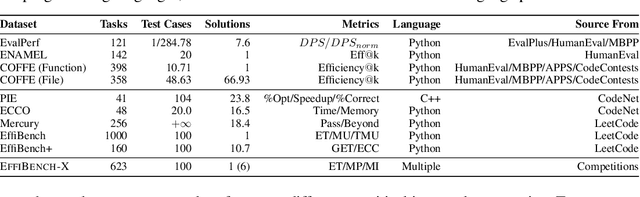
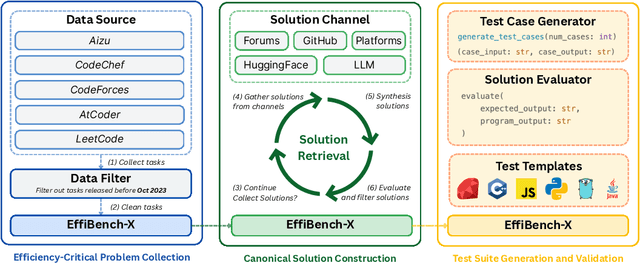
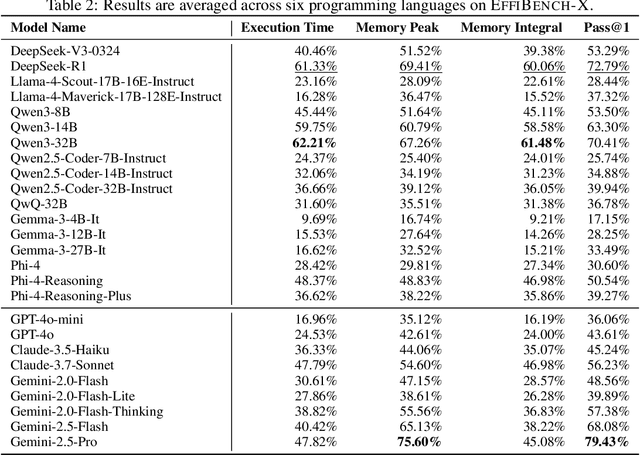
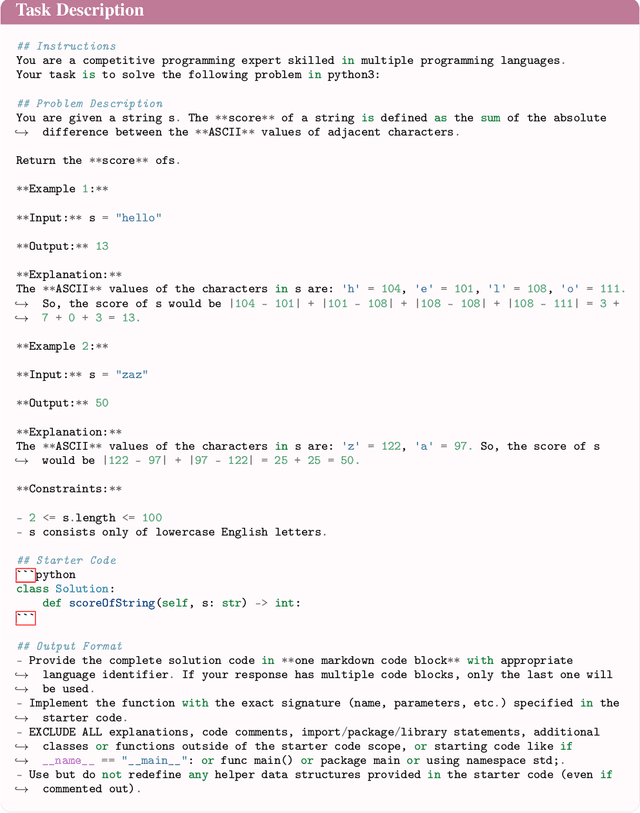
Existing code generation benchmarks primarily evaluate functional correctness, with limited focus on code efficiency and often restricted to a single language like Python. To address this gap, we introduce EffiBench-X, the first multi-language benchmark designed to measure the efficiency of LLM-generated code. EffiBench-X supports Python, C++, Java, JavaScript, Ruby, and Golang. It comprises competitive programming tasks with human-expert solutions as efficiency baselines. Evaluating state-of-the-art LLMs on EffiBench-X reveals that while models generate functionally correct code, they consistently underperform human experts in efficiency. Even the most efficient LLM-generated solutions (Qwen3-32B) achieve only around \textbf{62\%} of human efficiency on average, with significant language-specific variations. LLMs show better efficiency in Python, Ruby, and JavaScript than in Java, C++, and Golang. For instance, DeepSeek-R1's Python code is significantly more efficient than its Java code. These results highlight the critical need for research into LLM optimization techniques to improve code efficiency across diverse languages. The dataset and evaluation infrastructure are submitted and available at https://github.com/EffiBench/EffiBench-X.git and https://huggingface.co/datasets/EffiBench/effibench-x.
Bridging the Gap between Continuous and Informative Discrete Representations by Random Product Quantization
Apr 07, 2025Self-supervised learning has become a core technique in speech processing, but the high dimensionality of its representations makes discretization essential for improving efficiency. However, existing discretization methods still suffer from significant information loss, resulting in a notable performance gap compared to continuous representations. To overcome these limitations, we propose two quantization-based discretization methods: Product Quantization (PQ) and Random Product Quantization (RPQ). PQ partitions the original feature space into multiple subspaces and independently quantizes each sub-vector, producing a fused set of discrete units that retain diverse information from different subspaces, thus mitigating the loss associated with single-cluster quantization. RPQ further enhances representation diversity by randomly sampling a fixed proportion of feature dimensions multiple times to construct sub-vectors, thereby better capturing the variability in the data distribution. Theoretical analysis shows that RPQ reduces the correlation coefficient rho (where 0 <= rho <= 1) between sub-quantizers. Its quantization error is lower-bounded by the product of rho and epsilon-kms, where epsilon-kms denotes the quantization error of a single K-means quantizer. Experimental results on a combined dataset built from LibriSpeech and ML-SUPERB show that PQ and RPQ outperform standard K-means discretization, achieving relative improvements of 21.8 percent and 20.0 percent in WER on LibriSpeech, and 24.1 percent and 19.6 percent in CER on ML-SUPERB, respectively. Moreover, their performance is competitive with, and in some cases even surpasses, that of continuous SSL representations.